






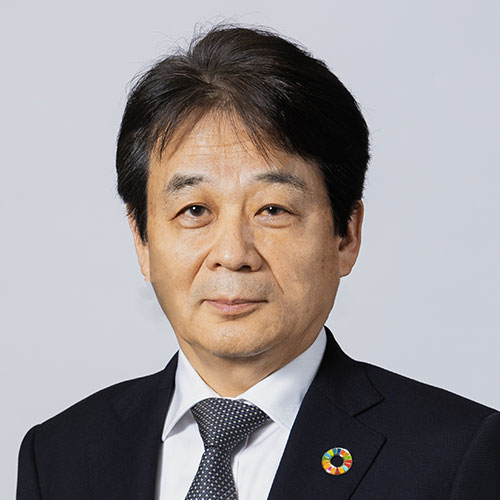
Toshiaki Takimoto is Director, Senior Executive Vice President of Corporate Strategy & Planning at INPEX CORPORATION (INPEX), the largest oil and gas exploration and production company in Japan. He assumed this role in 2026 and is also in charge of Legal Affairs, Compliance and is Head of Low Carbon Business.
Prior to his current position, from 2024 to 2025 Mr. Takimoto served as Director and Executive Vice President of Corporate Strategy & Planning, from 2023, he served as Senior Vice President of Hydrogen & CCUS Development, responsible for hydrogen, ammonia and CCUS/CCS projects. In 2019, he assumed his role as Managing Executive Officer. Before getting involved in net zero businesses, he was Senior Vice President of New Ventures & Global Exploration, taking the lead in exploration, technical evaluation, M&A and business development of oil & gas upstream projects. From 2018 to 2019, he served as Executive Officer, Senior Vice President of America and Africa Projects and was responsible for E&P projects in the Americas and Africa region.
Mr. Takimoto has almost 40 years of experience in upstream operations and new business development in the Americas, Africa, Europe and Japan. He has spent 4 years in Venezuela Caracas Office, and 3 years in London Office, both as General Manager. He was involved in various projects and new business development in Latin America, the Caspian Sea region, including the ACG oil field in Azerbaijan and the Kashagan project in Kazakhstan where he led INPEX’s business development and operations. He was also in charge of locating upstream business opportunities in Sub-Saharan Africa, the Northern Atlantic Margin including Norway and northwestern Europe through leading technical evaluation work and commercial negotiations.



