




Supported by

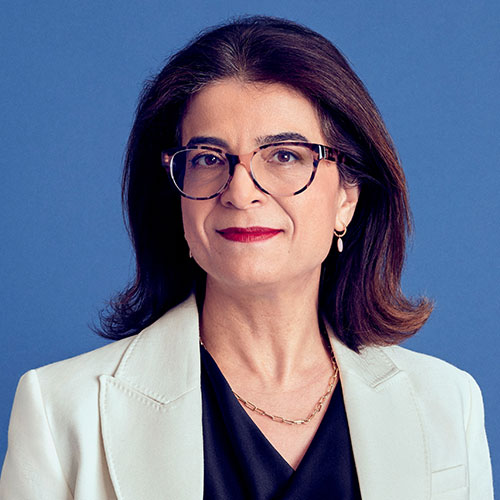
Hinda Gharbi

CEO

Bureau Veritas

Hinda
Hinda

Hinda Gharbi has served as Chief Executive Officer of Bureau Veritas since June 2023, following her appointment as Chief Operating Officer in May 2022 and Deputy Chief Executive Officer in January 2023. Since becoming CEO, Hinda has led Bureau Veritas’ strategic transformation through the LEAP | 28 framework, built around three pillars: Portfolio, People and Performance. Under her leadership, the Group has diversified its portfolio through more than 20 strategic acquisitions, strengthened its people model to support future growth and delivered sector-leading financial performance. Prior to joining Bureau Veritas, Hinda spent 26 years at SLB, where she held senior general management positions across global and regional operations before joining the Executive Committee in 2017. She holds a degree in Electrical Engineering from the École Nationale Supérieure d'Ingénieurs Électriciens de Grenoble and a Master of Science in Signal Processing from the Institut Polytechnique de Grenoble.

Session Overview
Tuesday, 3 November
14:10
Workforce & Skills Conference Room A 14:10 - 14:30
The agility mandate: protecting continuity as roles transform

For decades, technical careers in the energy sector were defined by long-term specialisation. That model is being reshaped by automation, AI, and evolving energy systems, shifting the focus from static roles to adaptable, skills-based career pathways. The challenge now extends beyond preparing for future roles to maintaining institutional continuity as capabilities evolve over time. Role transformation occurs at the task level, as automation and new workflows reshape how work is executed. Organisations that can distinguish between enduring tasks, those requiring heightened human judgement and those reshaped by AI are better positioned to redeploy talent with speed and precision, while preserving institutional knowledge as work evolves. This requires operating frameworks that maintain safety, technical capability and institutional knowledge, while enabling the dynamic mobilisation of talent across functions and business models. The organisations that treat workforce agility as an operational discipline, instead of a change management programme, will protect continuity while competitors are still managing disruption.

Attendee Insights:
Explore the shift from static job descriptions to skills-based architectures, and examine how internal talent marketplaces and task-level redesign enable rapid redeployment while preserving institutional knowledge.

Member of