






Under the patronage of His Highness Sheikh Mohamed bin Zayed Al Nahyan, President of the UAE, in his capacity as Ruler of Abu Dhabi

تحت رعاية صاحب السمو الشيخ محمد بن زايد آل نهيان ، رئيس الدولة "حفظه الله"، بصفته حاكماً لإمارة أبوظبي

Supported by

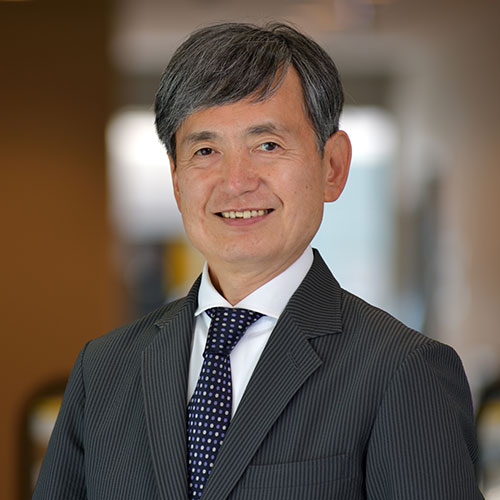
Koji Yamamoto

CTO

JOGMEC

Koji
Koji

Koji Yamamoto is a Senior Councilor and the Chief Technology Officer at the Japan Organization for Metals and Energy Security (JOGMEC). He earned his Ph.D. from Tohoku University in 2004, specializing in acoustics, reservoir geomechanics, and numerical modeling. His career spans both the private consulting sector and government organizations, where he has led numerous R&D projects addressing challenges in petroleum field development. The Middle East is one of his key areas of interest, and he has been actively involved in various projects in the UAE and other countries in the region. More recently, Dr. Yamamoto has expanded his focus to include the development of carbon capture and storage (CCS) and low-carbon fuel initiatives, such as blue hydrogen and ammonia. He currently oversees teams engaged in several multinational and international collaborative projects. In addition to his professional work, Dr. Yamamoto lectures on technical subjects at Kyoto University and Kyushu University. He also serves as the Asia-Pacific Regional Director for the Society of Petroleum Engineers.

Session Overview
Tuesday, 3 November
16:05
AI, Digital & Technology Plenary Hall B 16:05 - 16:35
AI investment priorities: identifying high-impact, scalable applications

AI capabilities in the energy sector are evolving faster than many roadmaps can accommodate. The challenge for organisations is not access to technology, but the discipline to prioritise investment towards applications that are genuinely high-impact and scalable, rather than being drawn towards noise and experimentation. Leading organisations have moved beyond this by identifying a small number of high-conviction AI initiatives and committing to them with sustained investment. Examples from renewables optimisation, smart mobility and predictive infrastructure management demonstrate that focus, not breadth, is the common factor in organisations achieving measurable business-wide progress. The next wave of high-value applications is beginning to emerge, and the window for first-mover advantage is narrowing. Organisations with rigorous investment frameworks will outperform those that continue spreading resources across experimentation at the expense of scalable returns.

Attendee Insights:
Explore how leading organisations have prioritised AI investment into scalable technologies that deliver tangible, business-wide progress.

16:25
AI, Digital & Technology Plenary Hall B 16:25 - 17:05
AI investment priorities: identifying high-impact, scalable applications
AI capabilities in the energy sector are evolving faster than many roadmaps can accommodate. The challenge for organisations is not access to technology, but the discipline to prioritise investment towards applications that are genuinely high-impact and scalable, rather than being drawn towards noise and experimentation. Leading organisations have moved beyond this by identifying a small number of high-conviction AI initiatives and committing to them with sustained investment. Examples from renewables optimisation, smart mobility and predictive infrastructure management demonstrate that focus, not breadth, is the common factor in organisations achieving measurable business-wide progress. The next wave of high-value applications is beginning to emerge, and the window for first-mover advantage is narrowing. Organisations with rigorous investment frameworks will outperform those that continue spreading resources across experimentation at the expense of scalable returns.
Attendee Insights:
Explore how leading organisations have prioritised AI investment into scalable technologies that deliver tangible, business-wide progress.

Member of